Arts and Crafts Movement
Craftsmanship, good materials, and design for everyday life in nineteenth-century
21/11/2025 Antiques
In the second half of the nineteenth century, Europe was changing its face at a speed never seen before: factories were growing, cities were expanding, objects of everyday use came out in series from machines that were increasingly efficient.
In this context the Arts and Crafts Movement was born in Great Britain, which was not only a style but an idea of society: to restore dignity to manual work, to the beauty of small things, to the quality of materials. The critic and art historian John Ruskin, with books such as The Stones of Venice, denounced the dehumanizing effects of industrialization and supported the “truth of materials” (that is, the respect for the natural properties of wood, metal, textiles, without masking them with fake decorations) and the moral value of craftsmanship. William Morris put these principles into practice: he founded workshops, designed furniture, wallpapers and textiles, imagined houses where every detail was coherent and well made. Around them worked figures such as the architect Philip Webb, Charles Robert Ashbee with his Guild of Handicraft and C. F. A. Voysey, an architect and author of essential and functional furniture. They all shared a simple idea: a beautiful and durable object makes everyday life better because it unites utility and pleasure.
On the philosophical level, Arts and Crafts arises from the recovery of the ethics of medieval guilds (“guilds”, associations of trades), where the master passes on knowledge and a responsibility toward the community. Beauty is not a luxury but a widespread quality, within reach of those who live in well cared for environments, with honest furnishings and good materials. Aesthetically this translates into clear lines, harmonious proportions, a sober decoration that grows out of the very structure of the object: if a chair has a backrest in bent wood, its shape is not covered, it is shown; if elements of wrought iron appear, they are functional and, at the same time, elegant. The wood is often “ebonized” or left natural, with open pore, so as to enhance the grain; the fabrics are in wool or linen, often dyed with colors inspired by nature, with motifs that refer to flowers, leaves and animals rendered with a clear and repeated design.
To understand the spirit of the movement it is enough to look at some objects. The Sussex chair, produced by Morris and Co. and attributed for the design to Philip Webb, is a small armchair in turned wood with a seat in woven rush: light, sturdy, economical, designed for domestic life more than to decorate (c. 1870s, London, William Morris Gallery).
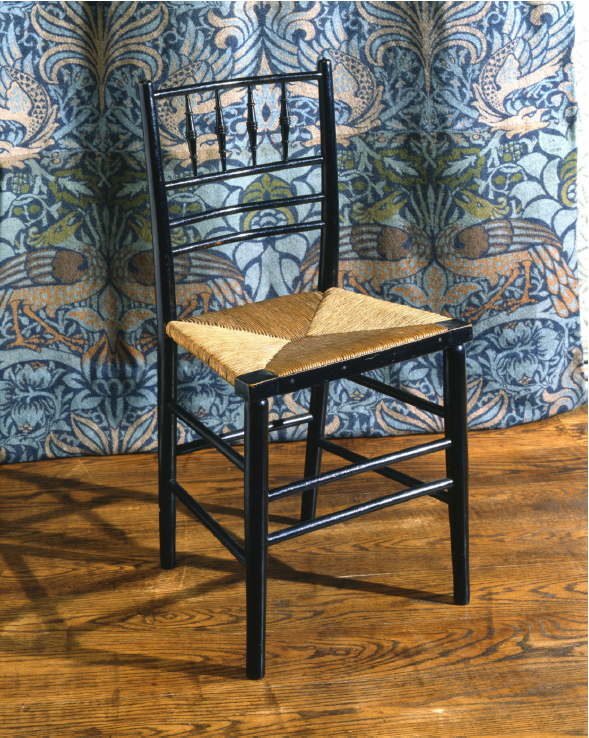
Morris & Co., Sussex chair, c. 1870s. London, William Morris Gallery
Morris was also a great creator of furnishing textiles. The Peacock and Dragon of 1878, in wool, shows stylized birds and vegetal motifs arranged in a firm and serene rhythm: it is decoration, but also “soft architecture”, because it covers walls and interiors adding visual and warmth (1878; New York, Metropolitan Museum of Art).
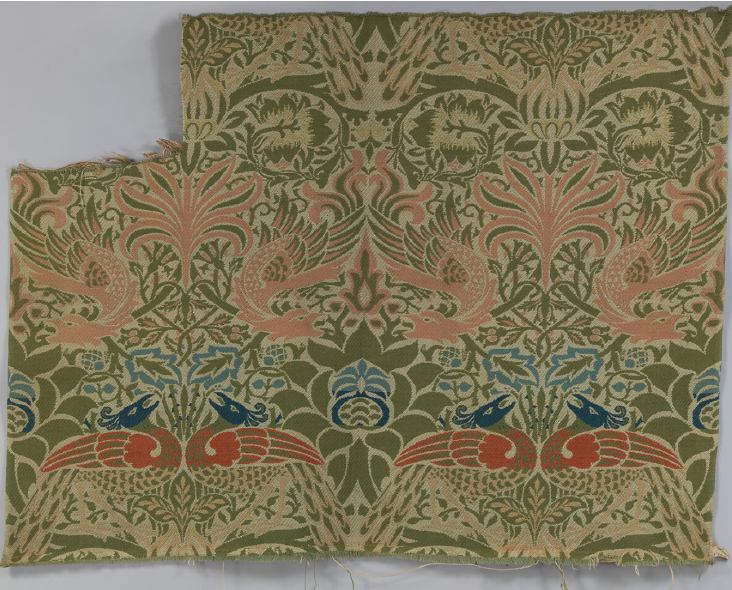
Morris & Co., Peacock and Dragon, 1878. New York, Metropolitan Museum
Alongside Morris, Charles Robert Ashbee founded the Guild of Handicraft to unite training and production. His cups and bowls in silver clearly show the idea of “truth of materials”: lightly hammered surfaces that catch the light without hiding the handwork, small applications of enamel or hard stones. An example is the Covered bowl with enamel produced in London around 1899 to 1900 (London, Victoria and Albert Museum).
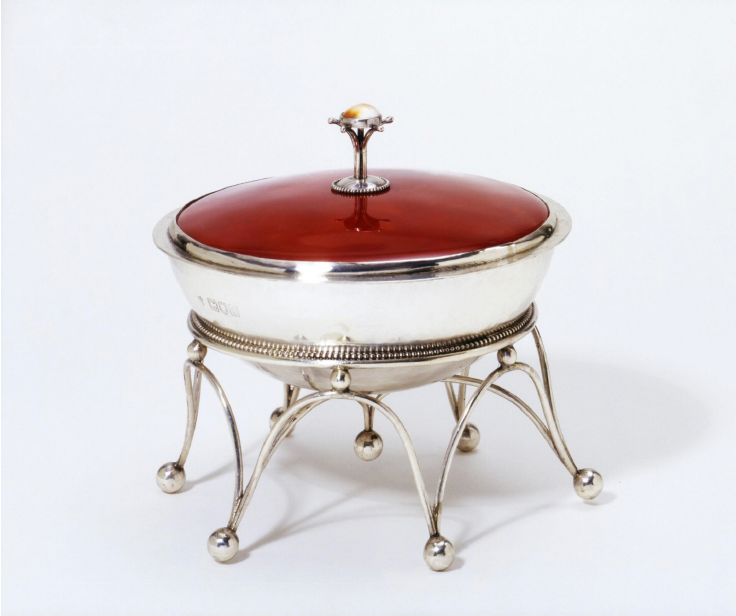
Guild of Handicraft Ltd., Covered Bowl, 1899-1900. London, Victoria and Albert Museum
C. F. A. Voysey interpreted Arts and Crafts in an essential key. His sideboard of 1897 has a structure of oak, brass hardware and clean geometries: no superstructures, only clear proportions and a construction that reveals joints and thicknesses (1897, Los Angeles County Museum of Art).
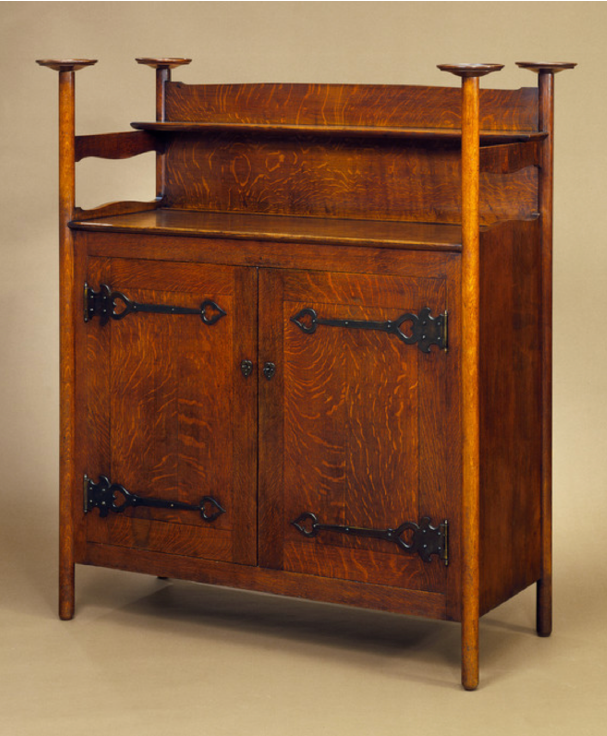
Charles Francis Annesley Voysey, Sideboard, 1897. Los Angeles County Museum of Art
The influence of Arts and Crafts soon crossed British borders and reached the United States, where interpretations such as the “Craftsman Style” were born. The original core, matured between the eighteen sixties and the end of the century, remains a symbol of quality and a beauty that arises from work well done. Looking today at a Sussex chair or a sideboard by Voysey we do not see a nostalgic return to the past: we see a very modern idea of sustainability, using durable materials, producing less but better, designing for real use. It is perhaps the most current legacy of the movement: to remind us that form and function can coexist without rhetoric and that the best design continues to serve us for generations.