Bohemian Glass
Tradition, innovation, and the art of transparency
05/12/2025 Antiques
When we hear people speak about “Bohemian glass” we immediately think of sparkling goblets, colourful vases and large chandeliers, but behind these objects there is a long story that begins in the forests of central Europe. Bohemia, a region that today corresponds to the Czech Republic, was rich in quartz sand, wood, water and limestone, all ideal ingredients for the production of glass, and from the late Middle Ages and the Renaissance the glassmakers of the area learned how to use these resources to their advantage.
During the 16th and 17th centuries they perfected a recipe that would make them famous: the use of potash (a salt obtained from wood ash) combined with gypsum, which produced a clear, hard and very stable glass, different from Venetian glass but just as brilliant and above all perfect for engraving and cutting.
At the beginning of the seventeenth century, at the court in Prague of Emperor Rudolf the Second, the gem cutter Caspar Lehmann applied to glass the same techniques he used for hard stones, carving the surface with small copper and bronze wheels: in this way the great Bohemian tradition of wheel engraving was born (that is, a decoration created by pressing the glass against a rotating abrasive wheel), which made it possible to create figures, coats of arms, landscapes and complex scenes directly on the walls of the glasses.
From that moment Bohemia became one of the cradles of European glass: large beakers decorated with enamel and gold leaf, with imperial emblems and heraldic motifs, were produced for clients spread throughout the German speaking world; one example of this early production is a beaker dated 1599, in cobalt blue glass with gold leaf and enamel decoration, now in the J. Paul Getty Museum in Los Angeles, which shows the level reached by Bohemian glassmakers as early as the end of the 16th century.
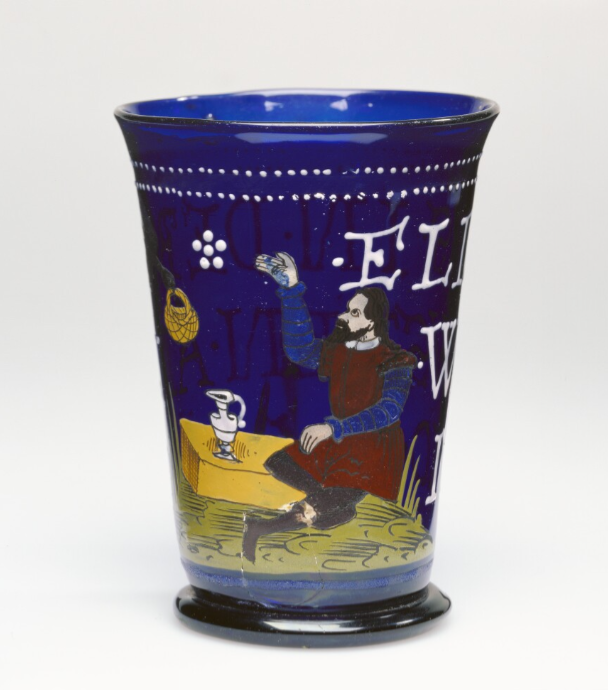
Beaker, 1599. Los Angeles, J. Paul Getty Museum
Between the 16th and 18th centuries Bohemian glass experienced a real golden age: the new “Bohemian crystal” imitated the brilliance of rock crystal and rivalled the glass of Murano, but had a different quality, more solid, ideal for engraving, grinding (that is, cutting and faceting the surface with abrasive wheels) and sometimes colouring the material in the mass. Large covered goblets, decorated with hunting scenes, heraldic motifs or allegories, circulated at court as prestigious gifts; at the same time a more popular glass developed, with enamel decoration that told religious stories, proverbs and moments of everyday life.
In the 19th century, as society became increasingly bourgeois, Bohemian glass entered homes on a stable basis as table service and decorative object, but it continued to renew itself from an aesthetic point of view: faceted glasses and jugs, coloured vases, richly enamelled and gilded pieces were created for a clientele that loved romantic and historical styles. This taste is well represented by an opal glass beaker made in Bohemia between 1850 and 1860, decorated with enamel and gilt flourishes and now in the Metropolitan Museum of Art in New York, which combines a simple, practical form with a rich ornamental surface clearly designed for the drawing rooms of the new middle class.
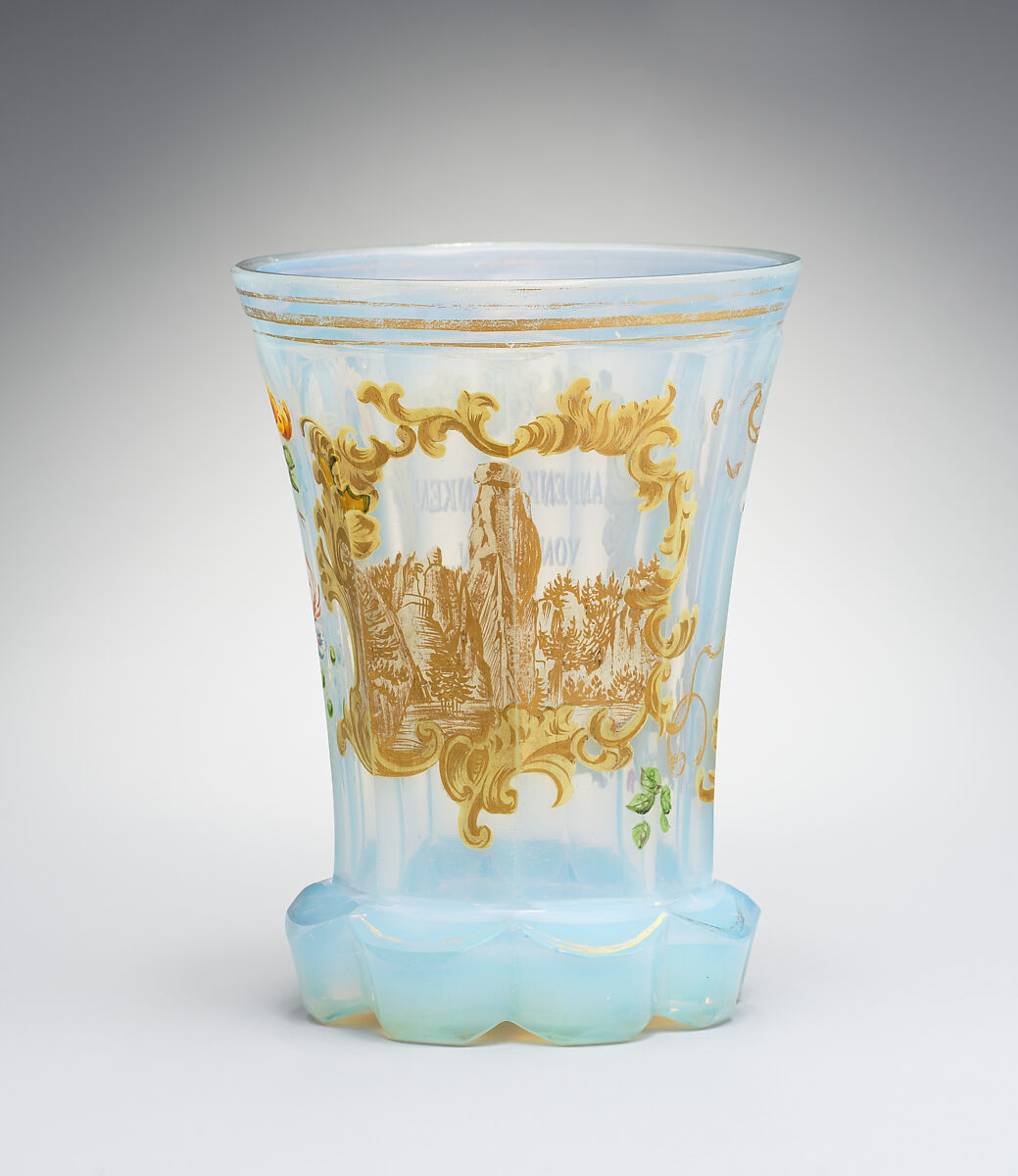
Beaker 1850-1860. New York, Metropolitan Museum
Between the 19th and the 20th century the Bohemian tradition met Art Nouveau and glass became a fluid material full of shimmering reflections. For an example from this Art Nouveau phase, see the vase in the “Streifen und Flecken” pattern, made around 1900 to 1903 by Johann Loetz Witwe, possibly after a design by Koloman Moser, now in the collection of the Corning Museum of Glass.
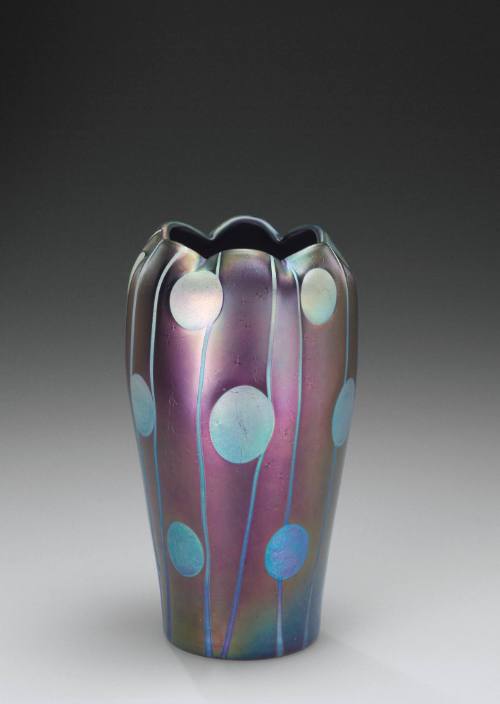
Johann Lötz Witwe (Bohemian Factory), Vase in “Streifen und Flecken” (Stripes and spots) Pattern, ca. 1900-1903
At the same time the Moser factory in Karlovy Vary, founded in 1857 by the engraver Ludwig Moser, became famous for its lead free crystal, very brilliant, entirely handmade and destined for courts and royal families; within a few decades Moser services, presented at great international exhibitions, would become one of the symbols of Bohemian luxury between the nineteenth and twentieth centuries.
The 20th century did not put an end to this story, but transformed it. After the birth of Czechoslovakia in 1918, Bohemian glass took on more geometric lines with Art Deco, adapted to modern life with functional yet elegant services and, especially after the Second World War, became a true autonomous artistic language.
It was precisely in Bohemia and in the new Czechoslovakia that some of the most important experiences of what is called studio glass were born (that is, artistic glass produced directly by the artist in the studio, in small series), such as the large cast glass sculptures by Stanislav Libensky and Jaroslava Brychtova, who from the 1950s onward explored the relationship between glass, light and space with blocks of cast glass in deep colours, also presented at the world fairs in Brussels in 1958 and Montreal in 1966.
For an example of this new way of understanding glass, see The Cube in Sphere, a cast glass sculpture created between 1978 and 1979 in which a cube seems to be suspended inside a transparent sphere: the work, now in the Toledo Museum of Art, condenses in a single object the couple’s interest in geometry, transparency and what they themselves called matter of light.
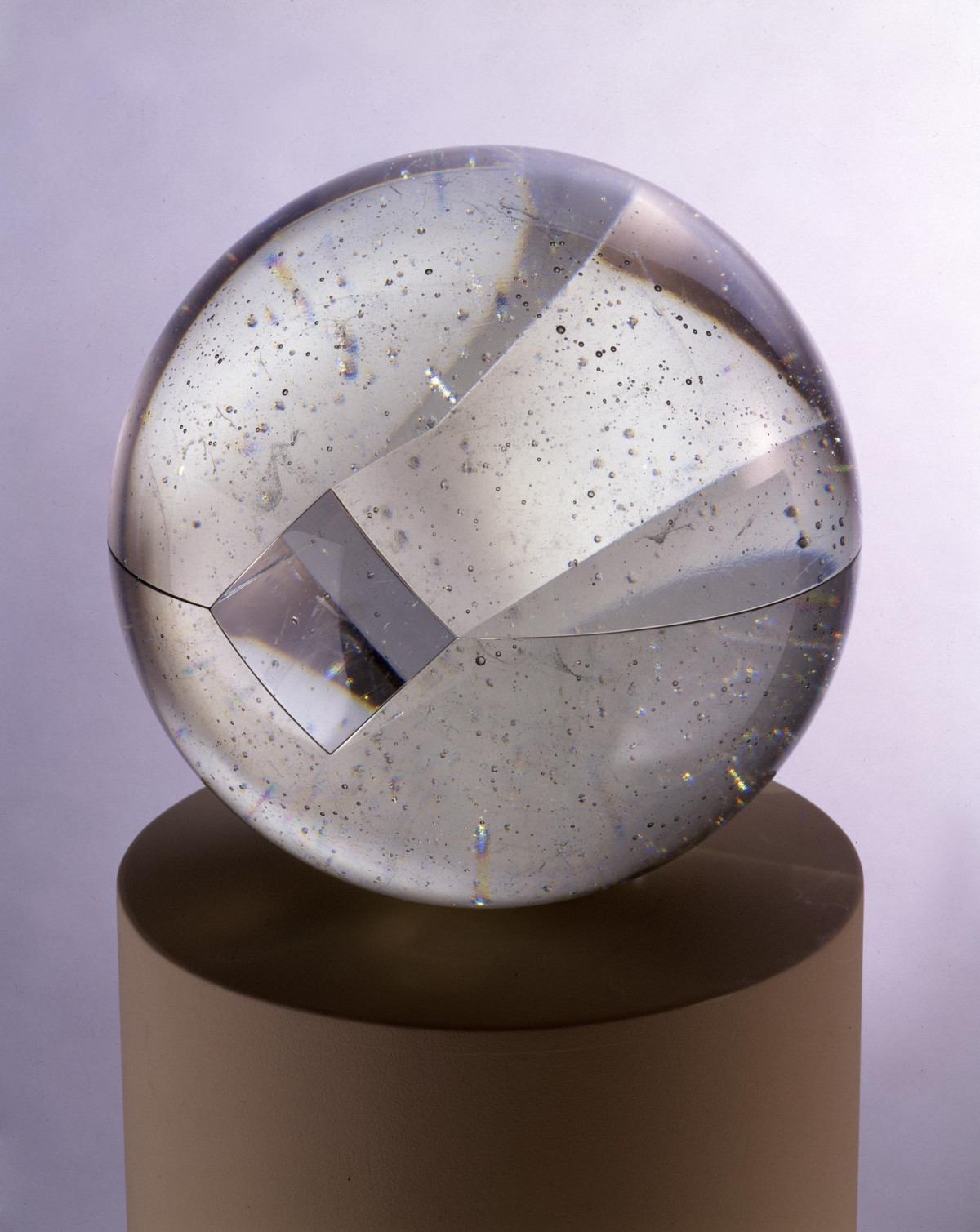
Stanislav Libensky and Jaroslava Brychtova, The Cube in Sphere, 1978-1979. Toledo Museum of Art
In those same decades companies such as Moser or Crystalex continued to produce Bohemian crystal services for hotels, restaurants and families all over the world, while the glass schools and factories of northern Bohemia trained generations of masters who carried on ancient techniques with a contemporary sensibility. Today Bohemian glass can be a large enamelled goblet from the seventeenth century, a liberty style iridescent vase, a whisky set with an essential design or an abstract cast glass sculpture: very different objects that nevertheless have something in common, which is the ability to capture light and turn it into a story, showing that a material that seems fragile can in fact cross centuries of history and remain always modern.