Building the City
How art has depicted urban transformation through the centuries
24/10/2025 Art History
Living in the UAE means witnessing change every day: cities in constant growth, new skylines rising, streets and districts transforming including not only private buildings but new museums and cultural institutions. This constant transformation doesn’t just define the urban landscape; it nurtures a cultural energy that has turned the region into a vibrant stage for exhibitions, fairs, and artistic dialogue.
These changes have affected not only the people living in these areas but also the artists. We will explore how artists of the past captured the city as it rose before their eyes. In ancient Rome, construction was a symbol of pride and identity: the so-called Crane Relief from the Mausoleum of the Haterii (early 2nd century CE, Vatican Museums) celebrates a family of builders through the image of a great wheel crane, a true icon of the ancient construction site.
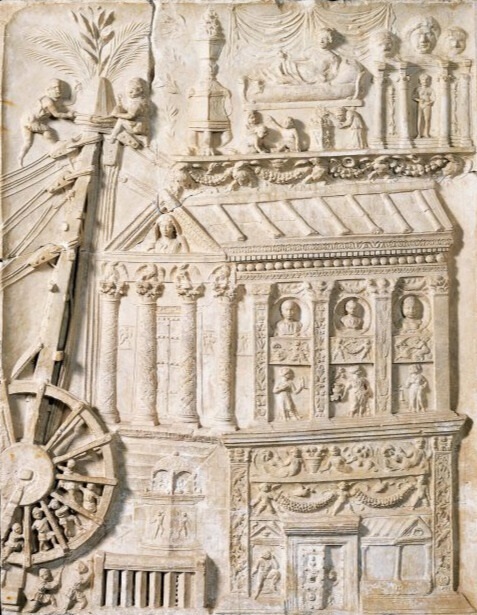
Crane relief from the Tomb of the Haterii on the Via Labicana, (Rome), early 2nd century CE. Vatican City, Vatican Museums
In the same way, the frieze of Trajan’s Column (113 CE, Rome) shows bridges, fortifications, and excavations, revealing how for the Romans, to build meant to shape and master the world around them.
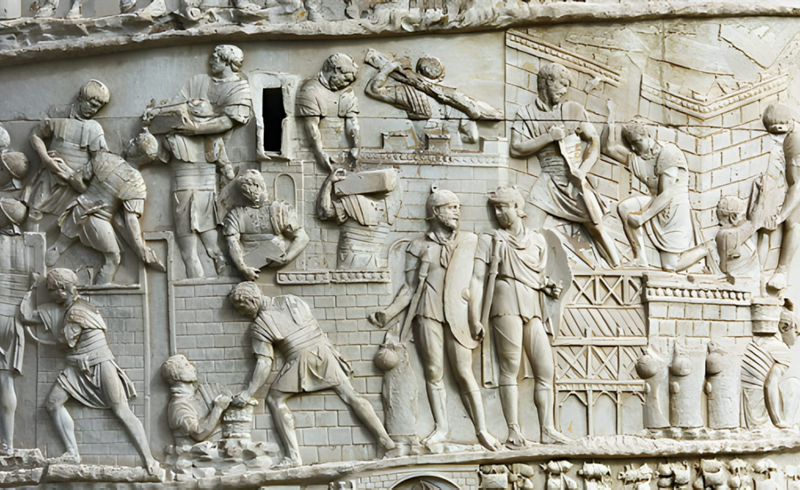
Roman soldiers building a defensive wall. Trajan’s Column (detail), 113 CE, Rome
Even before Rome, the idea of a city under construction was born in Mesopotamia. In the Perforated Relief of Ur-Nanshe (ca. 2550–2500 BCE, Paris Musée du Louvre), the king of Lagash carries a basket of bricks on his head and, in the next scene, celebrates the inauguration of a temple. In a single stone panel, we see labor, ritual, and power united: building is not just a technical act but a public gesture that gives shape and legitimacy to the community.
Perforated Relief of Ur-Nanshe, ca. 2550–2500 BCE. Paris Musée du Louvre
In the Middle Ages, building takes on a moral and spiritual meaning. The Tower of Babel in The Crusader Bible (ca. 1240s, New York, The Morgan Library & Museum) shows cranes, pulleys, and ramps at its center with almost “manual-like” precision, yet the construction site is an allegory of human ambition and the danger of excess.
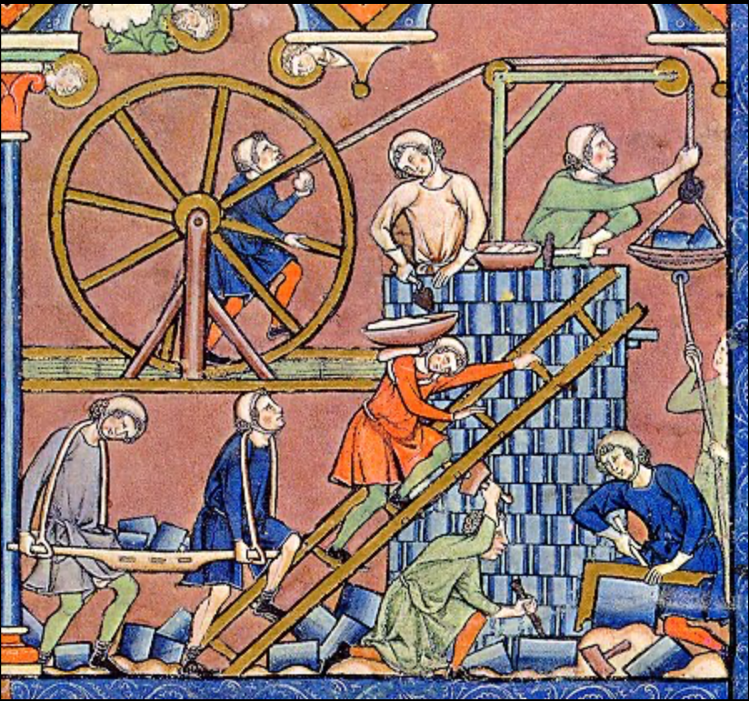
The Construction of the Tower of Babel.
The Crusader Bible, ca. 1240s. New York, The Morgan Library & Museum
With the Renaissance and the early modern age, the relationship between the city and the construction site became more structured and interconnected. In The Tower of Babel (1563, Kunsthistorisches Museum, Vienna), Pieter Bruegel the Elder turned the ancient myth into a vast urban scene where quarries, bridges, scaffolds, and workers form a living system. What matters is not only what is being built, but how the act of building reshapes daily life and social order.
_-_Google_Art_Project_-_edited.jpg)
Pieter Bruegel the Elder, The Tower of Babel. 1563, Vienna, Kunsthistorisches Museum
In the nineteenth century, with modernization, the city under construction becomes both documentation and analysis: Charles Marville, Percement de l’avenue de l’Opéra (Construction of the avenue de l’Opéra, December 1876), captures the great transformation of Paris, when entire neighbourhoods were demolished to create wide, orderly boulevards under Napoleon III and Baron Haussmann. His “neutral” yet powerful photographs reveal the city in transition, showing how progress was built through rubble, dust, and scaffolding.
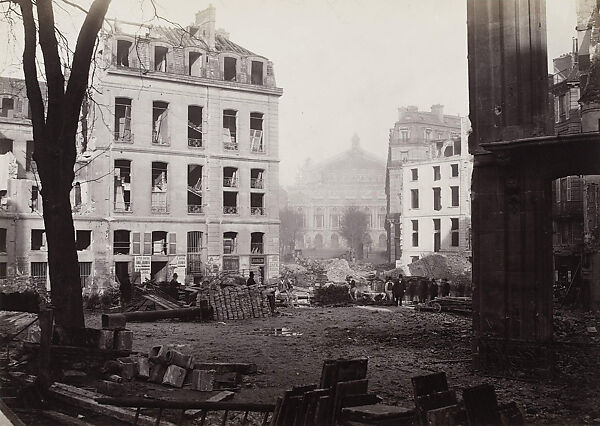
Charles Marville, Percement de l’avenue de l’Opéra (Construction of the avenue de l’Opéra),December 1876. Albumen silver print from glass negative. Paris, Musée Carnavalet
The avant-gardes of the twentieth century pushed this idea to its limit, turning the construction site into a source of visual energy. In The City Rises (1910, Museum of Modern Art, New York), Umberto Boccioni merges workers, horses, cranes, and scaffolds into dynamic lines that seem to make the air itself vibrate.
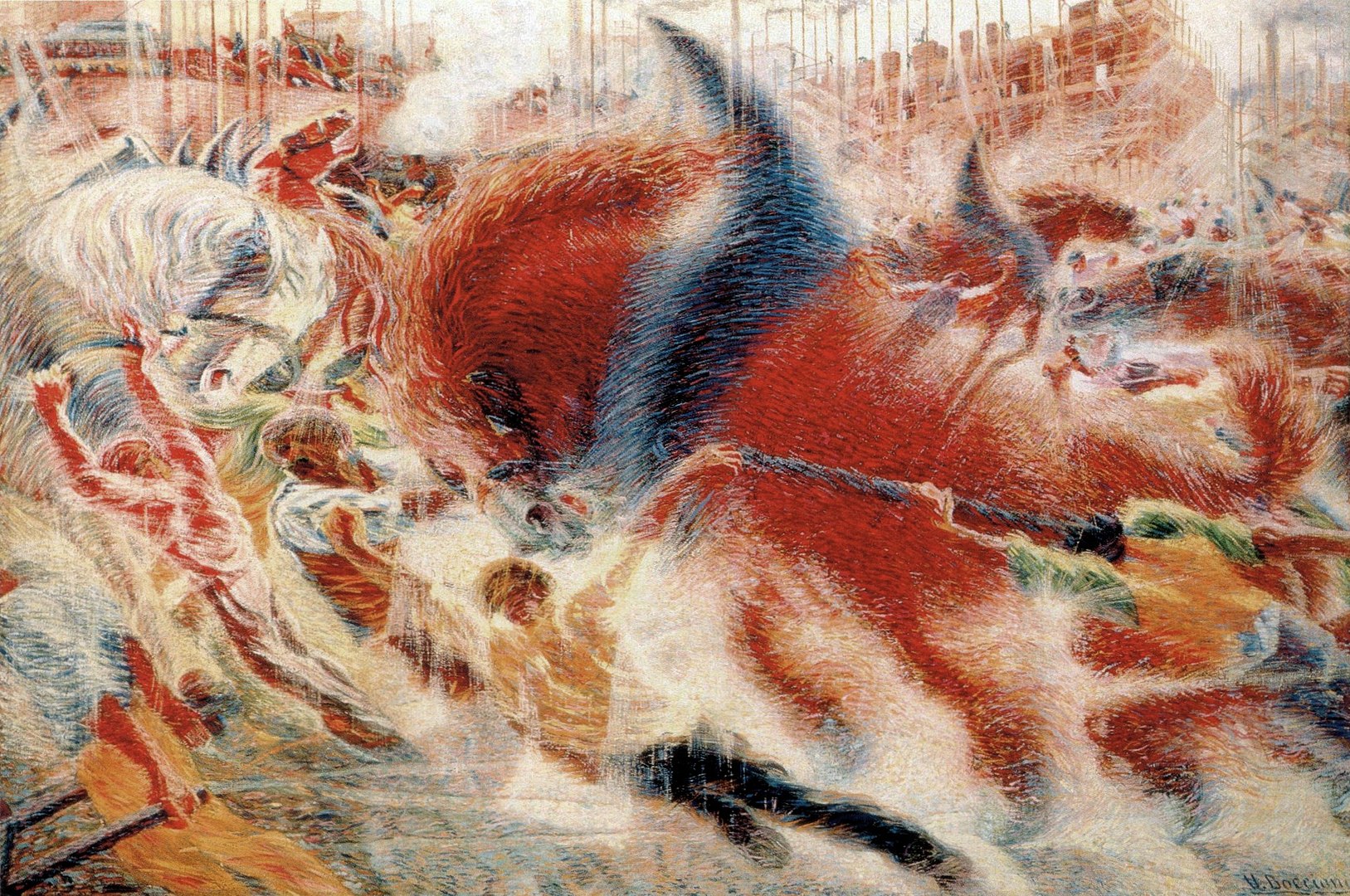
Umberto Boccioni, The City Rises, 1910, New York, Museum of Modern Art
And, in another Mediterranean of the twentieth century, Inji Efflatoun turns the construction site into a vibrant stage of collective effort in Construction Workers (1950, Dalloul Art Foundation, Beirut): groups of laborers move rhythmically across the canvas, their gestures echoing the pulse of a modern world under construction. Rather than depicting power or machinery, Efflatoun focuses on human energy: the determination, exhaustion, and solidarity that give the city its true foundations.
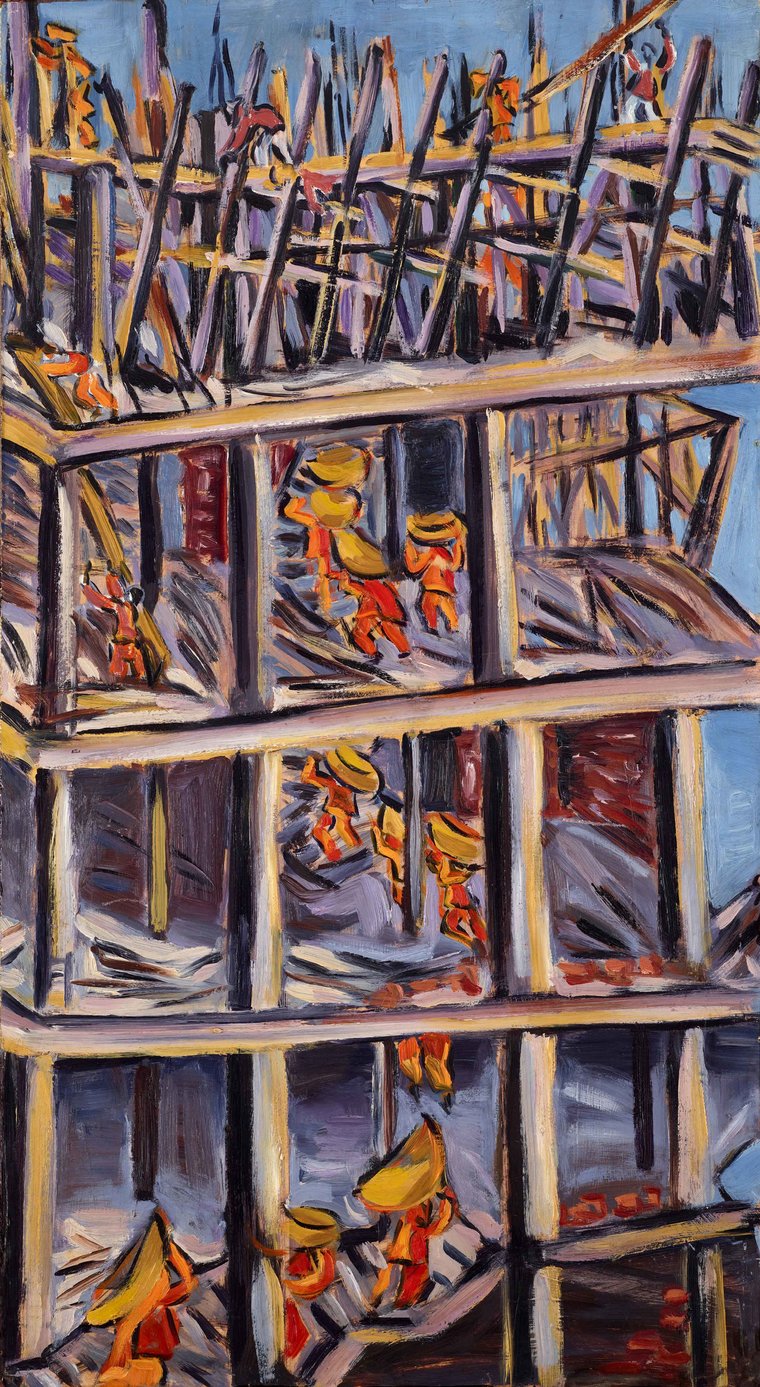
Inji Efflatoun, Construction Workers, 1950. Beirut, Dalloul Art Foundation
Meanwhile, in The City (1919, Philadelphia Museum of Art), Fernand Léger breaks down girders, stairways, billboards, and façades into modular shapes and interlocking forms. The modern metropolis becomes the language of the machine, a place constantly built and rebuilt, like a vast visual construction site.
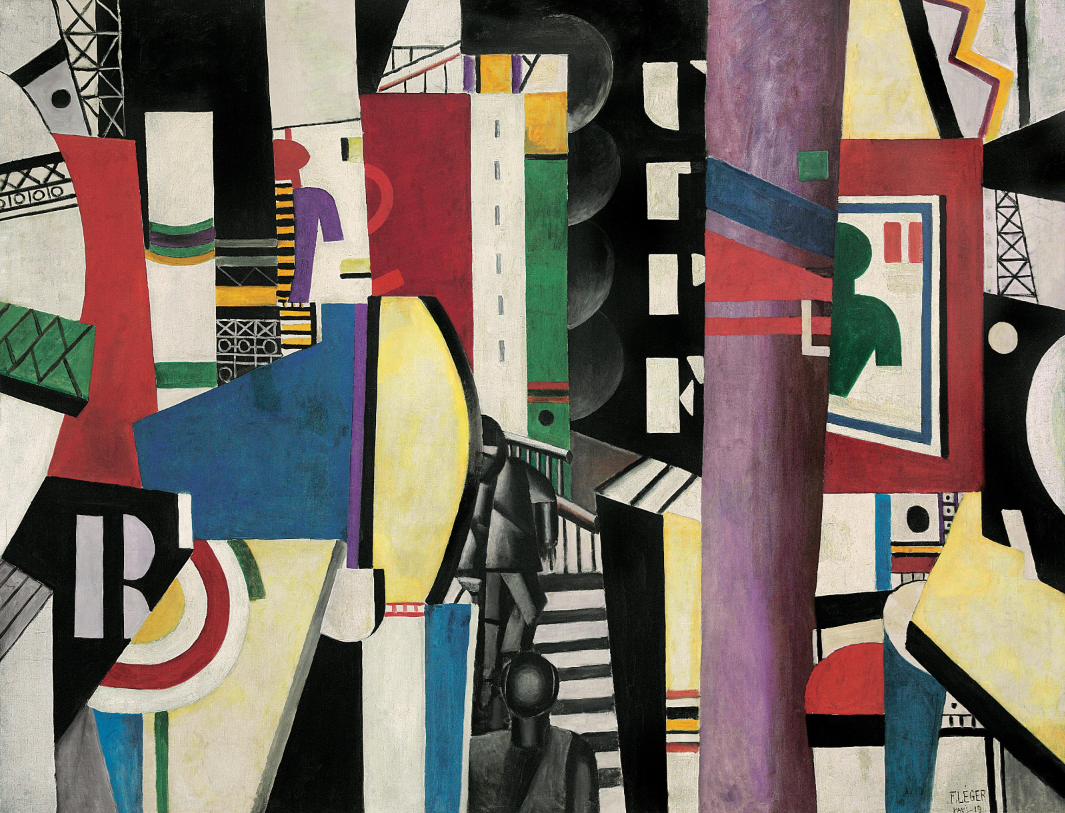
Fernand Léger, The City, 1919. Philadelphia Museum of Art
Seen together, these works trace a clear thread through time. In the Roman era, building affirms power by organizing both matter and people. In the Middle Ages, it becomes a reflection on order and proportion. In Bruegel’s vision, it turns into a landscape of shared effort and human pride. In the nineteenth century, it records transformation and explores the balance between destruction and creation. In the twentieth, it evolves into rhythm, movement, and abstraction.