Cubism and Modernity
Rejecting the conventions of art
30/07/2024 Art Market
As often happens in the art of 20th-century avant-gardes, it is not what but how something makes the difference. Many subjects painted by the masters of the 20th century belong to the grand tradition of Western art: nudes, landscapes, portraits, etc.
Let’s imagine being in the 19th century and having one of these catalogs in our hands. We haven’t visited the Salon yet, and in the catalog, we read: Georges Braque, Violin and Palette. We might expect to find a classic and academic still life, perhaps echoing the Dutch still lifes of the 17th century.
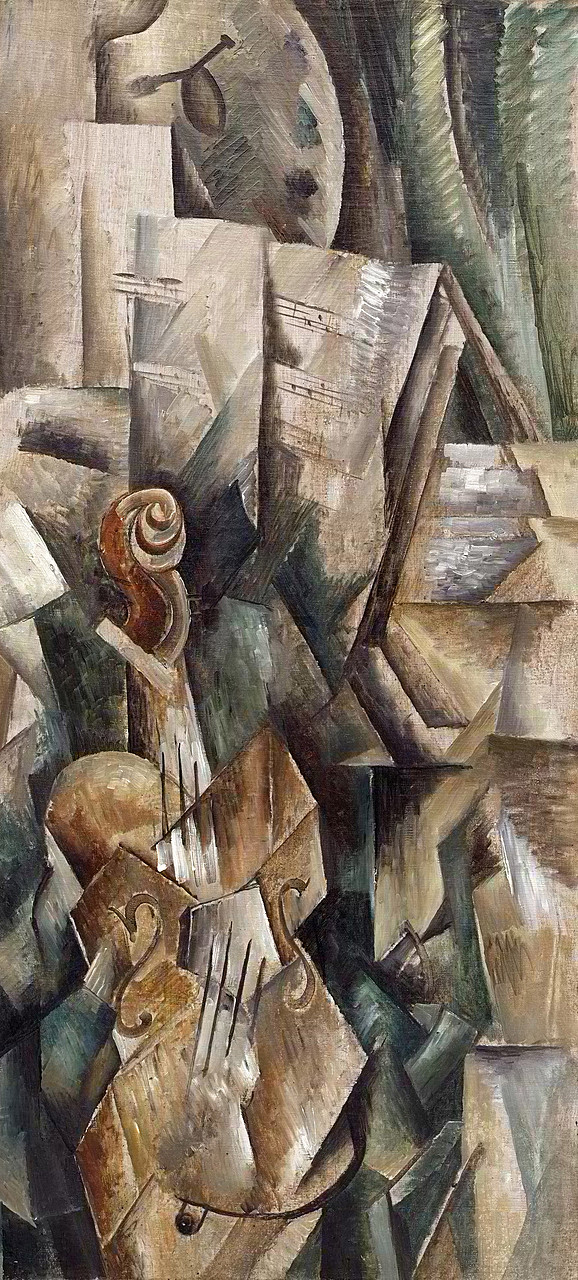
But Braque is not an artist of the 19th century, and, above all, his work Violin and Palette is from 1909. The subject of the painting is classic and traditional, but not its execution. The painted nail at the top and its shadow clearly reveal, with irony, the enormous distance between a still life from the past and this painting. In Braque, and generally in Cubism, the conventions of Western painting are rejected. It is only an illusion that perspective gives an exact perception of reality – as if we were looking at the world around us while standing still and leaning out of a window.
Reality is not a beautiful picture to hang on the wall (as the nail at the top seems to suggest). Reality is constantly alive and present, continuing to live even in memory and the unconscious (see Surrealism). We perceive an object, yes, here and now, but we have also perceived it in the past, and surely we will continue to do so in the immediate future. This is why the step from Cubism to Futurism is short, and from the representation of space, we will move on to the representation of time.
“Paris change!” sings Baudelaire, and Braque and the Cubists try to grasp and freeze in space the Paris of modern times that is changing. That modern era in which life and space are fragmented finds its unity in the canvas of the painting, where objects are represented not through the filter of Renaissance perspective but by juxtaposing their three dimensions on the two-dimensional surface of the painting. Art renounces the ambition to represent the real and finally becomes part of reality. No longer a mirror of the world but present in the world.