Historic manufactories
Meissen, Sèvres, Ginori and the geography of European taste
28/11/2025 Antiques
When we think of porcelain, we often imagine delicate objects locked in a display cabinet, but in reality those cups, vases and plates tell a real story of the geography of European taste, made of courts, fashions and dreams of distant lands.
Meissen, Sèvres and Ginori are not only prestigious marks but they are three places on the map that help us understand how Europe in the eighteenth and nineteenth centuries created its own style by looking at the world, imitating it and then reinventing it. Everything starts in Meissen, near Dresden, where at the beginning of the eighteenth century the first great European manufactory of true hard paste porcelain is founded, wanted by Augustus the Strong, elector of Saxony and king of Poland, a ruler famous not only for his physical strength but also for his taste with which he transformed Dresden into a centre of art and baroque splendour, making porcelain a symbol of his power and his modernity.
A small piece like the Teapot with equestrian scene (1722–23) shows this world very clearly, with tiny riders and figures in costume animated on a compact body and turning an everyday object into a miniature stage, today preserved at The Metropolitan Museum of Art, New York. The white of the porcelain becomes the scene on which the life of the Saxon court meets the fantasy of Chinese style decoration that so fascinated European elites, enchanted by the goods that arrived from Asia.
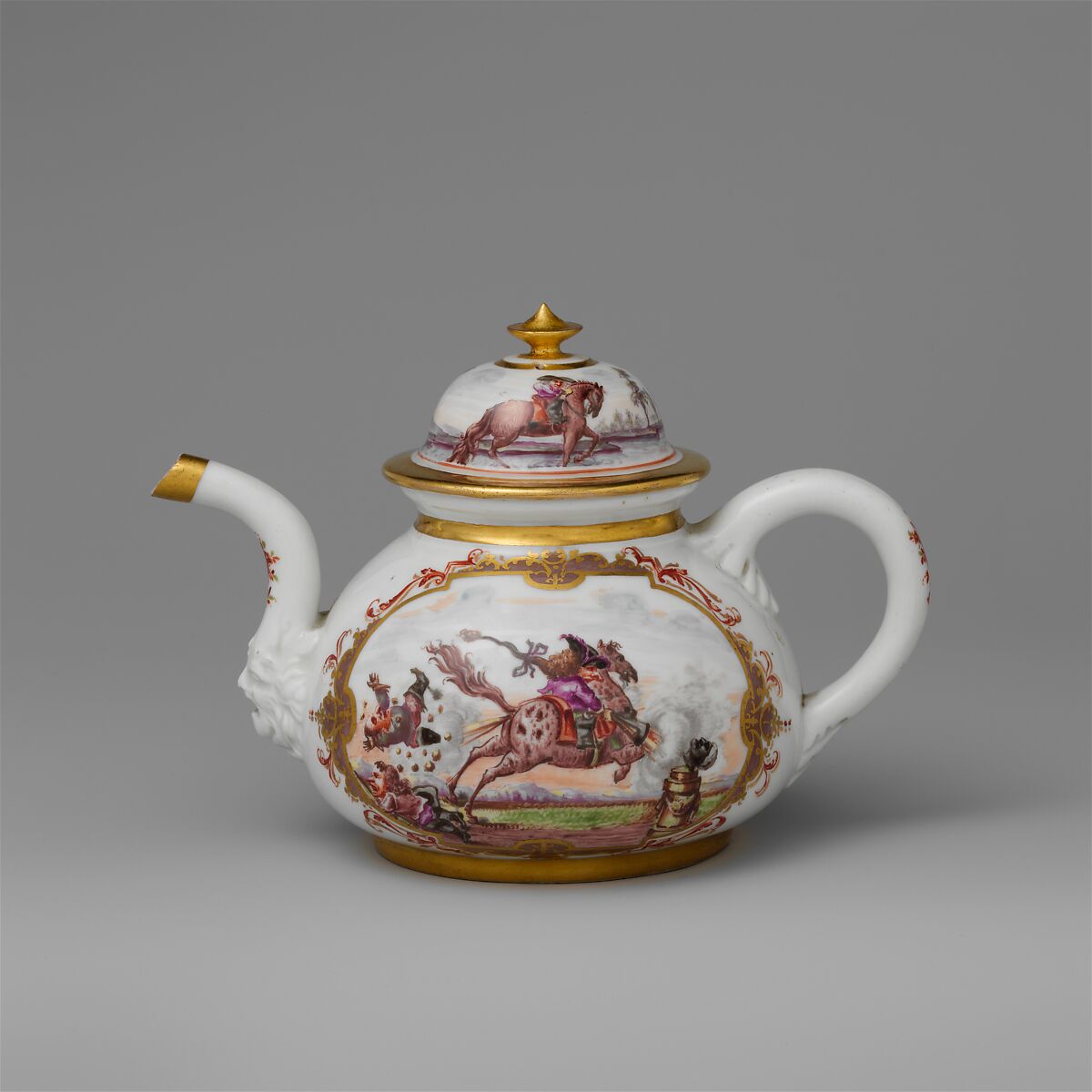
Meissen Manufactory, Teapot with equestrian scene, 1722-1723. New York, Metropolitan Museum
Some decades later the centre of gravity moves to France and to Sèvres, the royal manufactory near Paris, where porcelain becomes a tool of diplomacy, a precious gift for ambassadors and powerful families. In the pair Vases in Chinese style, called ‘vases Japon’ (1774), the oriental model is already filtered through a very French taste, the overall profile recalls certain Chinese pieces, but the colours, the gold and the way in which the surface is entirely covered with decoration speak the refined and slightly theatrical language of the world around Versailles, now in Louvre Abu Dhabi. It is amusing that these vases are called Japon even though they are inspired mainly by Chinese models, because for Europe at that time the Far East was more a container of exotic dreams than a precise geography.
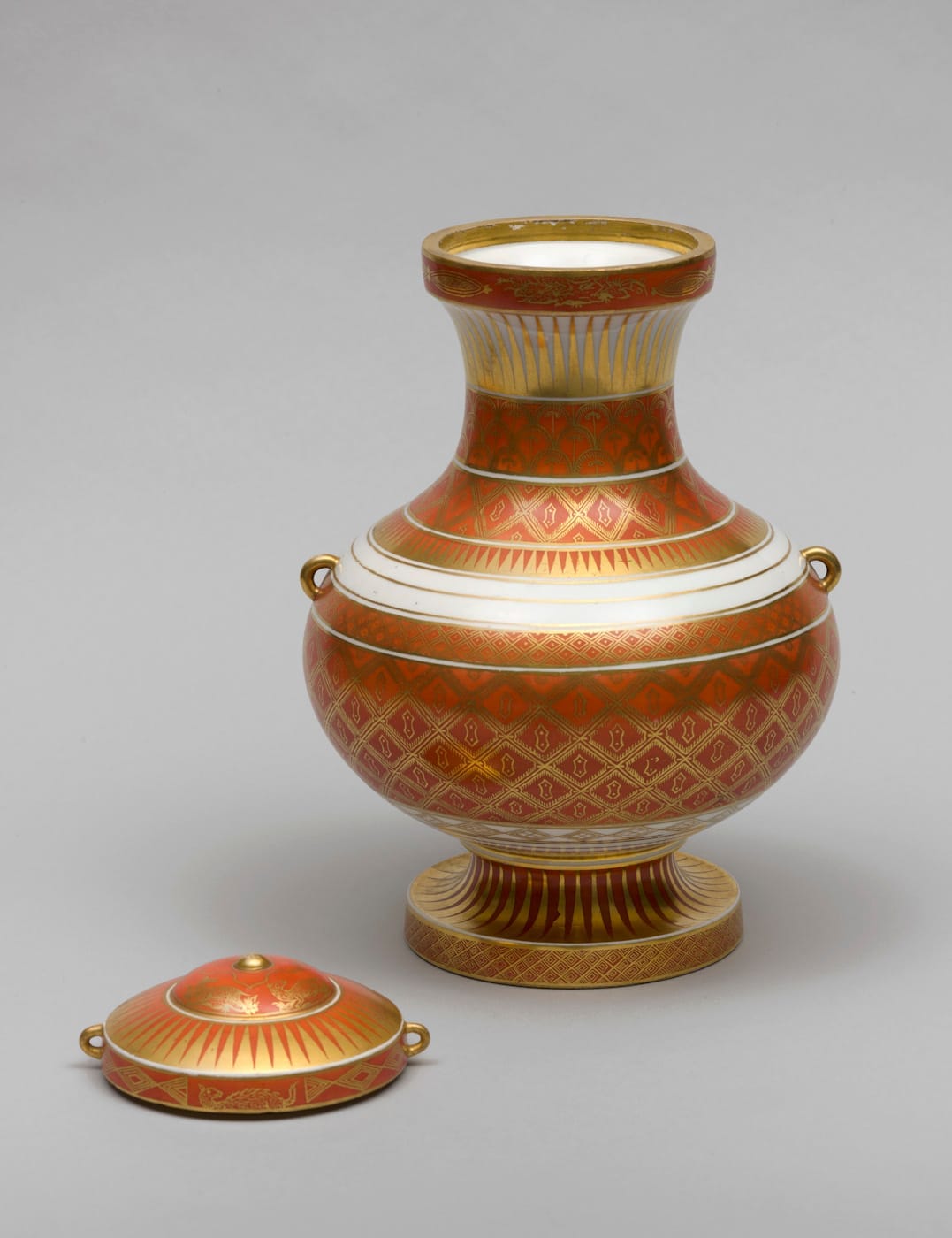
Royal porcelain Manufactory (Sèvres, France), Vases in Chinese style, called “vases Japon”, 1774. Louvre Abu Dhabi
Moving south we arrive in Italy, at the Ginori manufactory in Doccia near Florence, founded by Marquis Carlo Ginori in 1737. Here porcelain is not supported by a great royal court like in Dresden or Paris, but by an aristocrat passionate about science and antiquity who decides to translate into porcelain the heritage of statues, reliefs and images kept in the Medici collections.
A fascinating example of this curiosity for other cultures is the Platter (ca. 1745) decorated with so called Turkish figures, where men in turbans and oriental dress come from a Florentine manuscript with costumes from the Ottoman empire, now in The Metropolitan Museum of Art, New York.
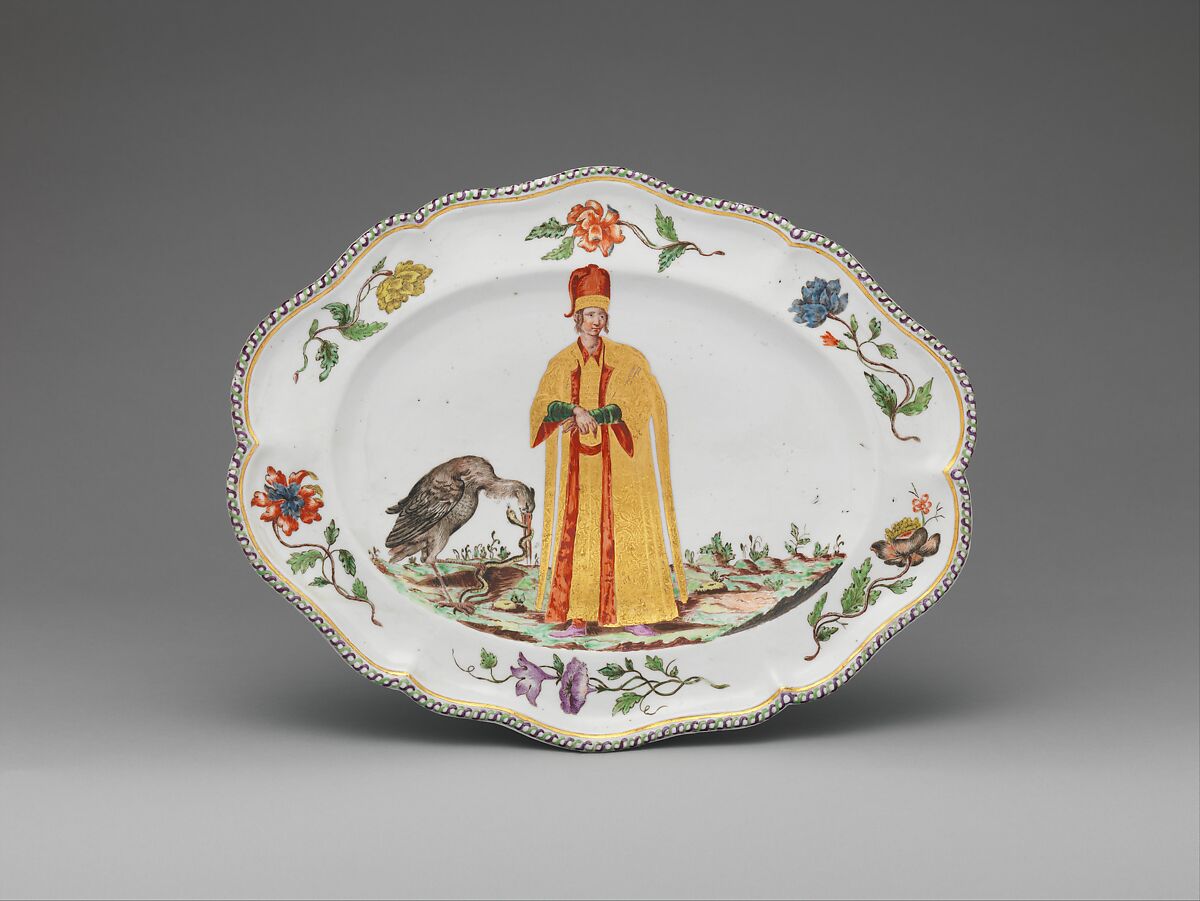
Doccia Porcelain Manufactory, Platter (one of a set), ca. 1745. New York, Metropolitan Museum
On a simple serving plate the European dining table opens toward the Mediterranean and the Islamic world, mixing the good service used for feast days. If we put these three places together, the map of European taste becomes clearer. In Meissen porcelain is a symbol of dynastic power, a luxury that shows equestrian parades, ceremonies and royal collections. In Sèvres it is a language of political seduction, a way of saying that France is the most elegant nation in Europe using vases, plates and coffee sets. With Ginori, Italy shows its ability to speak with the classical past but also with Istanbul and the cities of the Levant, following the routes of the sea. The most interesting part is that this geography is not only in history books.
It is enough to enter a museum like the Metropolitan or the Louvre Abu Dhabi, or simply to browse their online catalogues, to travel from Dresden to Paris and to Florence and discover that behind every famous piece of porcelain there is always an ambitious ruler, a curious collector or an artist who tried, with a plate or a teapot, to put the entire world on a table.